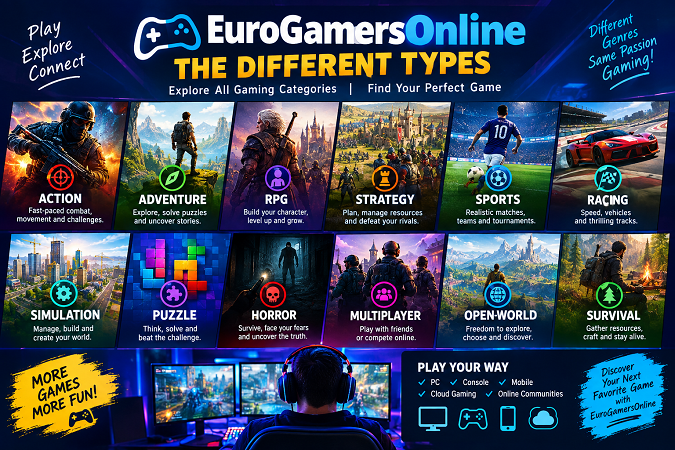

The gaming world has grown into a huge digital entertainment industry with something available for almost every type of player. From competitive esports and immersive role-playing adventures to strategy games, casual mobile titles, and multiplayer experiences, modern gamers can choose from countless genres and formats. This variety is one reason gaming platforms and communities continue to attract players from different backgrounds.When exploring eurogamersonline the different types, it is useful to understand how games can be categorised according to gameplay, platform, audience, multiplayer features, and overall experience. Knowing these categories can make it easier for players to discover games that match their interests and expectations.
EuroGamersOnline can be considered in the broader context of online gaming culture, where players look for information about games, genres, updates, communities, and entertainment. Rather than focusing on one particular style, the concept of different gaming types highlights how diverse the modern gaming landscape has become.
This guide explores the major types of games commonly found in online gaming environments and explains what makes each category different.
Also Read: ETSiOSApp Version From eTrueSports
What Does “EuroGamersOnline” Mean for the Different Types? Mean?
The phrase eurogamersonline the different types can be understood as an exploration of the different categories, formats, and experiences available to online gamers. The word “types” may refer to game genres, multiplayer formats, platforms, player communities, or gaming experiences.
Games are generally classified according to their primary gameplay mechanics. For example, an action game may emphasise fast reactions, while a strategy game focuses more heavily on planning and decision-making. Role-playing games often emphasise character development, exploration, and storytelling.
Online gaming adds another layer because players can interact with other people. Multiplayer games may involve cooperation, competition, communication, or a combination of all three.
Understanding these differences gives players a clearer picture of what they can expect before choosing a game.
Different Types of Games in Online Gaming
1. Action Games
Action games are among the most recognisable gaming categories. They generally require quick reactions, timing, movement, and interaction with the game environment.
Many action games include combat, exploration, platforming, or fast-paced challenges. Players often need to react quickly to changing situations while controlling their characters or vehicles.
The appeal of action games comes from their immediate gameplay. Players can quickly understand the basic objective and gradually improve their skills through practice.
2. Adventure Games
Adventure games are usually designed around exploration, storytelling, puzzles, and discovery. Instead of focusing entirely on fast combat, they often encourage players to investigate environments and follow a narrative.
Adventure games can take place in fantasy worlds, historical settings, science-fiction environments, or realistic locations. Some titles combine adventure mechanics with action, role-playing, or puzzle-solving features.
For players who enjoy discovering new locations and following stories, adventure games can provide an engaging experience.
3. Role-Playing Games
Role-playing games, commonly called RPGs, allow players to control characters and develop them throughout the game.
Character progression is one of the most important elements of RPGs. Players may gain experience, unlock abilities, collect equipment, complete missions, and make decisions that affect their journey.
Some RPGs are designed for single-player experiences, while others are online multiplayer games where players explore shared worlds together.
RPGs can also include different subcategories, including action RPGs, tactical RPGs, massively multiplayer online role-playing games, and story-driven RPGs.
4. Strategy Games
Strategy games focus heavily on planning, resource management, decision-making, and long-term thinking.
Players may need to manage armies, build cities, control resources, develop technology, or defeat opponents through careful planning.
Strategy games are often divided into real-time strategy and turn-based strategy.
In real-time strategy games, actions happen continuously, requiring players to make decisions quickly. Turn-based strategy games give players more time to consider their next move.
5. Sports Games
Sports games recreate real-world sports in digital form. Popular examples of sports categories include football, basketball, tennis, racing, cricket, and golf.
These games can range from realistic simulations to arcade-style experiences.
Sports games are particularly popular among players who already enjoy watching or participating in real-world sports. Multiplayer modes can also allow friends or competitors to play against one another.
6. Racing Games
Racing games focus on speed, vehicles, tracks, competition, and timing. Players may control cars, motorcycles, boats, aircraft, or other vehicles depending on the title.
Some racing games emphasise realistic physics and vehicle simulation, while others provide arcade-style controls designed for accessibility.
Online racing can add competitive elements by allowing players to race against opponents from different locations.
7. Simulation Games
Simulation games attempt to recreate activities, systems, or environments.
Players may manage businesses, build cities, operate vehicles, run farms, design houses, or experience virtual versions of everyday activities.
Simulation games can be relaxing because they often allow players to progress at their own pace. They can also be highly detailed, particularly when they attempt to accurately reproduce professional activities.
8. Puzzle Games
Puzzle games focus on logic, pattern recognition, problem-solving, memory, and observation.
They can be simple enough for casual players or extremely challenging for experienced gamers. Puzzle mechanics can also appear inside adventure, strategy, RPG, and other genres.
Because puzzle games often have relatively simple controls, they are especially common on mobile devices.
9. Fighting Games
Fighting games typically feature one-on-one or team-based combat. Players control characters with unique abilities, attacks, combinations, and defensive techniques.
These games often require timing, memorisation, reaction speed, and knowledge of different characters.
Competitive fighting games can also become part of esports communities, where players participate in organised tournaments.
10. First-Person Shooter Games
First-person shooters, or FPS games, present gameplay from the character’s first-person perspective. Players generally use weapons and other abilities to complete objectives or defeat opponents.
FPS games can include single-player campaigns, cooperative modes, and competitive multiplayer.
Competitive FPS games often emphasise communication, teamwork, map awareness, aiming, positioning, and fast decision-making.
Online Multiplayer Game Types
Online gaming is not limited to individual genres. Games can also be classified according to how players interact with each other.
Competitive Multiplayer
Competitive games place players or teams against one another. The objective may be to win a match, achieve a higher score, complete an objective, or outperform opponents.
Competitive gaming can range from casual matches with friends to organised esports competitions.
Cooperative Multiplayer
Cooperative games allow players to work together toward a shared objective. Players may complete missions, defeat enemies, solve puzzles, or build virtual environments as a team.
Cooperative gameplay can make communication and teamwork particularly important.
Massively Multiplayer Online Games
Massively multiplayer online games, often called MMOs, can support large online communities. Players may explore persistent virtual worlds, interact with other players, complete quests, trade items, and participate in group activities.
MMOs can combine role-playing, strategy, exploration, social interaction, and other mechanics.
Different Gaming Platforms
Another way to understand the different types of gaming is to examine the devices used to play.
PC Gaming
PC gaming offers a broad range of genres and customisation options. Players can use keyboards, mice, controllers, racing wheels, and other accessories.
PC platforms are especially popular for competitive games, strategy titles, simulations, MMORPGs, and games that benefit from extensive customisation.
Console Gaming
Gaming consoles provide dedicated hardware designed primarily for entertainment. Consoles are commonly connected to televisions or monitors and generally use controllers.
Console gaming is popular for action, sports, racing, adventure, fighting, and multiplayer games.
Mobile Gaming
The widespread use of smartphones and tablets has led to the rapid growth of mobile gaming. Mobile games are as simple as puzzles or as complex as multiplayer games.
The accessibility of mobile devices makes mobile gaming an important part of the wider gaming industry.
Table: Comparing Different Gaming Types
| Game Type | Main Focus | Typical Experience | Suitable For |
|---|---|---|---|
| Action | Fast reactions | Fast-paced | Players who enjoy intensity |
| Adventure | Exploration and story | Discovery-focused | Story and exploration fans |
| RPG | Character development | Progression-based | Long-term players |
| Strategy | Planning | Tactical | Strategic thinkers |
| Sports | Real-world sports | Competitive | Sports fans |
| Racing | Speed and driving | Competitive | Vehicle enthusiasts |
| Simulation | Real-life systems | Detailed | Creative and management-focused players |
| Puzzle | Problem-solving | Brain-focused | Casual and analytical players |
| Fighting | Combat | Competitive | Skill-focused players |
| FPS | Shooting and objectives | Fast multiplayer | Competitive players |
Why Understanding Different Game Types Matters
With thousands of games available, choosing the right one can sometimes be difficult. Understanding genres helps players narrow down their choices.
A player who enjoys storytelling may prefer adventure or RPG games. Someone who likes competition may enjoy fighting, racing, sports, or FPS titles. Players who prefer relaxed experiences might choose simulation or puzzle games.
Genre knowledge can also help parents and new players understand the general characteristics of different games before playing them.
The Role of Gaming Communities
Modern gaming is increasingly social. Players can communicate through text chat, voice communication, forums, streaming platforms, and online communities.
Gaming communities can share strategies, discuss updates, organise tournaments, and help newcomers learn game mechanics.
Platforms and websites associated with gaming culture can therefore become more than simple sources of entertainment. They can serve as information hubs where players discover new experiences and connect with other enthusiasts.
Esports and Competitive Gaming: Eurogamersonline the different types
Esports has created another important category within modern gaming. Competitive players participate in organised tournaments featuring games from genres such as FPS, strategy, fighting, sports, and multiplayer online battle arenas.
Professional esports can include teams, individual competitors, coaches, commentators, event organisers, and audiences.
For casual gamers, esports can also provide entertainment and inspiration. Watching experienced players can help viewers understand advanced strategies and techniques.
Casual Gaming vs. Hardcore Gaming: Eurogamersonline the different types
Not every player approaches gaming in the same way.
Casual gamers may play occasionally for relaxation and entertainment. They might prefer games that are easy to learn and can be completed in short sessions.
More dedicated players may spend several hours practising, competing, exploring, or progressing through a game. These players may also follow gaming news, updates, tournaments, and communities closely.
Neither approach is inherently better. They simply represent different ways of enjoying games.
How to Choose the Right Game Type: Eurogamersonline the different types
Choosing a game becomes easier when players consider a few basic questions.
First, think about the preferred pace. Fast-paced games may appeal to people who enjoy constant action, while slower games may be better for players who prefer planning.
Second, consider whether you want to play alone or with others. Single-player games provide individual experiences, whereas multiplayer games offer social and competitive interaction.
Third, consider the available platform. A game may be designed specifically for PC, console, mobile devices, or multiple platforms.
Finally, think about how much time you want to invest. Some games can be enjoyed in short sessions, while others are designed around long-term progression.
Future Trends in Online Gaming: Eurogamersonline the different types
The gaming industry continues to change as technology develops. Cloud gaming, improved graphics, artificial intelligence, virtual reality, augmented reality, and cross-platform multiplayer are influencing how players interact with games.
Online communities are also becoming increasingly important. Players can discover games through videos, livestreams, social media, gaming websites, and recommendations from other players.
These developments suggest that the idea of eurogamersonline the different types will continue to expand as new genres and gaming formats emerge.
(FAQs): About Eurogamersonline the different types
What does “eurogamersonline the different types” mean?
The phrase refers broadly to exploring different types of gaming experiences, including game genres, multiplayer formats, platforms, and gaming communities.
What are the main types of video games?
Common categories include action, adventure, RPG, strategy, sports, racing, simulation, puzzle, fighting, and first-person shooter games.
Which game type is best for beginners?
There is no single best type for every beginner. Puzzle, casual, adventure, and accessible sports games can be easier starting points, while some competitive genres may require more practice.
What is the difference between single-player and multiplayer games?
Single-player games are primarily designed for individual play, while multiplayer games allow two or more players to interact competitively or cooperatively.
What are esports games?
Esports games are titles that support organised competitive gaming, including tournaments and professional or semi-professional competitions.
Are mobile games different from PC and console games?
Mobile games are designed for smartphones and tablets and often use touch controls. PC and console games can support more specialised controls and hardware, although many modern games are available across multiple platforms.
What is an RPG?
RPG stands for role-playing game. RPGs commonly feature character development, progression systems, exploration, quests, equipment, and storytelling.
What is an FPS game?
FPS stands for first-person shooter. These games generally present gameplay from a first-person viewpoint and often focus on shooting, objectives, competition, or teamwork.
Why are gaming communities important?
Gaming communities allow players to exchange information, discuss strategies, find teammates, follow updates, and share their experiences with other gamers.
Will new types of games continue to appear?
Yes. Advances in technology and changing player preferences can create new combinations of genres, gameplay mechanics, platforms, and online experiences.
Conclusion: Eurogamersonline the different types
The concept of eurogamersonline the different types provides a useful way to explore the broad variety of modern gaming experiences. Action, adventure, RPG, strategy, sports, racing, simulation, puzzle, fighting, and FPS games each offer different gameplay styles.
Gaming can also be categorised by how people play, including single-player, cooperative, competitive, and massively multiplayer experiences. PC, console, and mobile platforms provide additional ways to access these games.
Understanding these categories helps players discover experiences that match their interests, preferred pace, available time, and desired level of competition. As gaming technology and online communities continue to evolve, the number of ways people can play, communicate, compete, and explore digital worlds will likely continue to grow.
For anyone researching eurogamersonline the different types, the most important takeaway is that gaming is not a single experience. It is a diverse ecosystem containing many genres, platforms, communities, and play styles.

Pingback: EuroGamersOnline.com Gadgets – Gaming Gear Guide 2026
Pingback: EuroGamersOnline From Consoles to Casinos | Gaming Evolution