
The gaming industry is changing faster than ever, and technology is at the centre of this transformation. From competitive esports tournaments to cloud gaming, artificial intelligence, advanced graphics, and high-speed connectivity, modern gaming has become much more than simply playing a video game. EtrueSports tech represents the broader connection between esports, gaming platforms, digital tools, and emerging technologies that are helping players and communities experience games in new ways.
Technology has changed almost every part of the gaming ecosystem. Players now have access to powerful gaming computers, high-refresh-rate monitors, sophisticated controllers, gaming smartphones, low-latency networks, and professional streaming equipment. At the same time, developers and esports organisers use data analytics, artificial intelligence, cloud infrastructure, broadcasting systems, and cybersecurity technologies to create more engaging experiences.
Understanding etruesports tech is therefore useful for gamers, esports fans, content creators, developers, and anyone interested in the future of interactive entertainment.
Also Read: Gaming Updates from EtrueSports EtrueGames
What Is EtrueSports Tech?
The phrase etruesports tech can be understood as a technology-focused concept surrounding modern esports and gaming. It includes the hardware, software, networks, platforms, services, and digital innovations that support competitive gaming and gaming communities.
Esports requires reliable technology because competitive matches depend on speed, accuracy, stability, and fair competition. A small delay in network communication can influence the result of a match. Similarly, poor hardware performance can affect a player’s ability to react quickly.
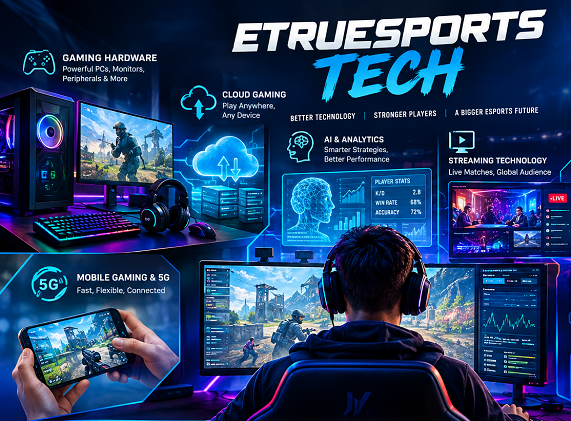
EtrueSports tech can therefore cover areas such as gaming hardware, esports software, streaming technology, cloud services, artificial intelligence, game analytics, internet connectivity, virtual environments, and digital communities.
The technology ecosystem continues to grow as gaming becomes increasingly connected with entertainment, social media, professional sports, and digital content creation.
Why Technology Matters in Esports
Technology is one of the most important foundations of modern esports. Professional players need equipment that can respond quickly and consistently. Tournament organizers need reliable systems to manage competitions, players, schedules, scores, broadcasts, and audiences.
For players, technology can improve responsiveness and comfort. A high-refresh-rate display can make fast-moving gameplay appear smoother, while a responsive mouse or controller can help players perform precise actions.
For audiences, technology provides high-quality live broadcasts, real-time statistics, player information, interactive chats, highlights, and social media content. Fans no longer have to be physically present at a tournament to follow their favourite teams.
Technology also makes esports more accessible. Online platforms allow players from different regions to compete, practise, communicate, and build communities without being in the same physical location.
EtrueSports Tech and Gaming Hardware
Gaming hardware is an essential part of the modern esports environment. Computers, consoles, smartphones, monitors, keyboards, mice, controllers, headsets, microphones, cameras, and networking equipment all contribute to the gaming experience.
A powerful processor and graphics system can help games run smoothly at high settings and frame rates. Storage technology can reduce loading times, while adequate memory allows modern games and applications to operate efficiently.
Gaming peripherals are equally important. Competitive players often choose equipment based on responsiveness, ergonomics, durability, and personal preferences. A professional gamer may spend considerable time selecting a mouse, keyboard, controller, headset, or monitor that matches their playing style.
The development of specialised gaming hardware demonstrates how technology continues to influence competitive performance.
Artificial Intelligence in Gaming and Esports
Artificial intelligence is becoming increasingly important across the gaming industry. AI can be used in game development, player behaviour analysis, matchmaking systems, virtual characters, customer support, moderation, and data analysis.
In esports, AI-based analytics can help teams examine gameplay patterns. Coaches and analysts can study statistics to identify strengths, weaknesses, strategies, and recurring mistakes.
AI can also improve the spectator experience. Automated systems may help organise statistics, identify important moments, generate highlights, or provide additional information during broadcasts.
Another potential application is intelligent game testing. Developers can use automated systems to test game environments and identify technical problems more efficiently.
As AI technology develops, its role in gaming and esports is likely to become even broader.
Cloud Gaming and EtrueSports Tech
Cloud technology is another major development affecting gaming. Traditional gaming often requires users to install games on local hardware. Cloud gaming moves some of the processing and infrastructure to remote servers.
With a suitable internet connection, players can potentially access games through supported cloud platforms without relying entirely on high-end local hardware.
Cloud technology can also benefit esports organisations. Online infrastructure can support tournaments, game services, data storage, communication, and digital distribution.
However, cloud gaming depends heavily on network quality. Latency, bandwidth, server distance, congestion, and connection stability can affect gameplay. This makes internet infrastructure an important part of the future of etruesports tech.
Streaming Technology and Esports
Streaming has transformed gaming from a private activity into a form of public entertainment. Platforms allow gamers to broadcast their gameplay to audiences around the world.
Modern streaming technology includes cameras, microphones, capture devices, encoding software, graphics, overlays, chat systems, and broadcasting infrastructure.
For esports, live streaming allows tournaments to reach enormous online audiences. Viewers can watch matches, follow statistics, communicate with other fans, and interact with creators.
Content creators also benefit from streaming technology because gaming channels can combine live gameplay with commentary, tutorials, reviews, entertainment, and community interaction.
As internet speeds and broadcasting technologies improve, gaming content is likely to become even more sophisticated.
High-Speed Internet and Low Latency
Internet connectivity is critical for competitive gaming. Online multiplayer games require continuous communication between players and game servers.
Latency refers to the time required for data to travel between a player’s device and a server. Lower latency generally provides a more responsive online experience.
For competitive esports, stable connectivity can be just as important as raw internet speed. A fast connection that frequently drops or experiences large latency fluctuations may create problems during matches.
Future developments in network infrastructure, server distribution, and wireless technologies could further improve online gaming experiences.
Data Analytics in Esports
Data has become a valuable resource in competitive gaming. Teams can collect information about player performance, match results, strategies, movement patterns, and other gameplay statistics.
Analysts can use this information to identify trends and make better decisions. For example, a team may examine previous matches to understand an opponent’s preferred strategies.
Data analytics can also support player development. Instead of relying only on observation, coaches can combine visual analysis with statistics to identify specific areas for improvement.
This combination of technology and human expertise is becoming an important part of professional esports.
Augmented Reality and Virtual Reality
Gaming technology could be another avenue for virtual reality and augmented reality.
Virtual reality is a special piece of hardware that puts the user inside an interactive digital world.
Augmented reality combines digital elements with the real-world environment.
While traditional esports remains dominated by conventional gaming platforms, immersive technologies could create new categories of competitive entertainment.
VR technology may eventually support more realistic training environments, interactive events, and entirely new competitive game formats.
EtrueSports Tech and Mobile Gaming
Mobile gaming has expanded rapidly because smartphones are widely available and increasingly powerful. Modern mobile devices can run complex games with advanced graphics and online multiplayer capabilities.
Mobile esports can provide opportunities for players who do not own expensive gaming PCs or consoles. This accessibility can help expand competitive gaming into new markets.
Smartphone technology is also improving through better processors, displays, cooling systems, batteries, and network connectivity. These developments could continue to increase the role of mobile gaming in the wider esports industry.
Cybersecurity in Esports
As esports becomes more digital, cybersecurity becomes increasingly important. Tournament platforms, player accounts, streaming systems, websites, and online communities can all face security risks.
Strong passwords, account protection, secure authentication, software updates, and responsible data management are important for players and organisations.
Tournament operators must also protect competitive systems against unauthorised access and other disruptions. Maintaining security helps preserve trust and fair competition.
Cybersecurity is therefore an important but sometimes overlooked component of etruesports tech.
Technology and the Future of Competitive Gaming
The future of esports technology will likely involve a combination of existing systems and emerging innovations. Artificial intelligence, cloud computing, advanced networking, immersive technologies, analytics, and increasingly powerful gaming hardware may all contribute to the next generation of gaming.
One important trend is the integration of different technologies. For example, an esports platform could combine cloud infrastructure, AI analytics, live broadcasting, real-time statistics, and interactive community features.
Another trend is accessibility. As hardware and internet technologies become more widespread, competitive gaming may become available to a larger global audience.
The gaming industry will continue to evolve, and technology will remain one of its strongest driving forces.
Key Areas of EtrueSports Tech
| Technology Area | Role in Gaming and Esports | Potential Benefit |
|---|---|---|
| Gaming Hardware | Runs games and supports players | Better performance |
| High-Refresh Displays | Improves visual smoothness | Faster visual feedback |
| Cloud Gaming | Provides remote game processing | Flexible access |
| Artificial Intelligence | Analyses data and supports systems | Smarter insights |
| Data Analytics | Studies gameplay and performance | Better strategies |
| Streaming Technology | Broadcasts gaming content | Global audiences |
| High-Speed Networks | Connects players and servers | Lower latency |
| Cybersecurity | Protects accounts and systems | Greater safety |
| VR/AR | Creates immersive experiences | New gaming formats |
| Mobile Technology | Supports portable gaming | Greater accessibility |
Benefits of EtrueSports Tech
One of the biggest benefits of gaming technology is improved accessibility. Players can now participate in gaming communities using PCs, consoles, smartphones, and other devices.
Another major benefit is connectivity. Online platforms allow players to communicate and compete with people from different parts of the world.
Technology also creates professional opportunities. Esports players, coaches, analysts, broadcasters, streamers, developers, designers, event organisers, and technical specialists can all participate in the gaming economy.
Innovation also improves entertainment. High-quality broadcasts, interactive statistics, professional production, and online communities make esports more engaging for viewers.
Challenges Facing Gaming Technology
Despite its advantages, technology also creates challenges. High-end gaming equipment can be expensive, which may create barriers for some players.
Internet quality is another concern. Players in areas with limited connectivity may have difficulty participating in competitive online gaming.
Privacy and cybersecurity are also important. Gaming platforms collect and process significant amounts of information, making responsible data protection essential.
There is also the challenge of keeping technology accessible while maintaining competitive fairness. Tournament organisers must establish rules that prevent hardware or software advantages from unfairly influencing competition.
How Gamers Can Benefit From New Technology
Gamers do not necessarily need the most expensive equipment to benefit from technology. The most important step is choosing hardware according to actual needs.
Players should prioritise stable internet connectivity, comfortable peripherals, appropriate displays, reliable software, and suitable hardware performance.
Learning to use analytics can also help competitive players improve. Reviewing match recordings and statistics can reveal mistakes that may not be obvious during live gameplay.
Content creators can benefit from better microphones, cameras, lighting, streaming software, and editing tools. These technologies can improve the quality of gaming content without changing the fundamental gameplay experience.
EtrueSports Tech as a Growing Digital Ecosystem
The concept of etruesports tech is broader than a single piece of hardware or software. It represents an ecosystem where gaming, technology, competition, entertainment, and online communities intersect.
As esports continues to develop, technology will remain central to how games are played, watched, analysed, streamed, and managed.
The future could bring more intelligent analytics, faster networks, improved cloud services, more immersive gaming environments, and increasingly sophisticated broadcasting systems.
For players and fans, this means the gaming experience will continue to evolve. What seems innovative today may become standard in the future.
(FAQs): About etruesports tech
1. What is etruesports tech?
EtrueSports tech refers broadly to the technology and digital innovations connected with modern gaming and esports, including gaming hardware, software, AI, cloud services, analytics, streaming, networking, and cybersecurity.
2. Why is technology important in esports?
Technology provides the infrastructure required for competitive gaming. It supports game performance, online connectivity, tournaments, broadcasting, player analytics, communication, and audience engagement.
3. How does AI affect esports?
AI can support gameplay analysis, statistics, matchmaking, moderation, game development, automated testing, and other processes. It can help teams and developers make better use of gaming data.
4. Does internet speed matter for competitive gaming?
Yes. Stable connectivity and low latency are particularly important for online competitive games. Connection problems can affect responsiveness and the overall gaming experience.
5. Is cloud gaming part of gaming technology?
Yes. Cloud gaming uses remote servers to process and deliver games to supported devices. Its effectiveness depends significantly on network quality and server infrastructure.
6. How does streaming help esports?
Streaming allows tournaments and gaming content to reach audiences worldwide. It also enables interaction through chats, social communities, live statistics, and other digital features.
7. What role does data analytics play in esports?
Data analytics can help teams study player performance, strategies, match history, and gameplay patterns. Coaches and analysts can use these insights to support training and decision-making.
8. Is mobile gaming part of the esports technology ecosystem?
Yes. Modern smartphones provide powerful processors, displays, networking capabilities, and gaming features, making mobile gaming an important part of the broader gaming industry.
9. What is the future of etruesports tech?
The future is likely to involve greater use of AI, cloud computing, advanced networking, data analytics, immersive technologies, improved hardware, and sophisticated streaming systems.
10. Can technology make esports more accessible?
Yes. Mobile gaming, cloud services, affordable hardware, and online platforms can reduce some traditional barriers and allow more people to participate in gaming communities and competitive experiences.
Conclusion: etruesports tech
EtrueSports tech highlights the important relationship between technology and the rapidly changing world of gaming and esports. From powerful hardware and high-speed internet to artificial intelligence, cloud gaming, data analytics, streaming, cybersecurity, and immersive technologies, innovation is influencing almost every part of the gaming ecosystem.
Technology can improve competitive performance, expand accessibility, connect global communities, and create new forms of entertainment. At the same time, challenges involving cost, connectivity, privacy, security, and competitive fairness must be addressed.
The future of gaming will not be defined by one technology alone. Instead, it will be shaped by the combination of many digital innovations working together. As these technologies continue to advance, etruesports tech can be viewed as part of a larger movement toward faster, smarter, more connected, and more interactive gaming experiences.
For gamers, esports professionals, developers, creators, and fans, keeping up with technological developments can provide valuable insight into where the gaming industry is heading next.