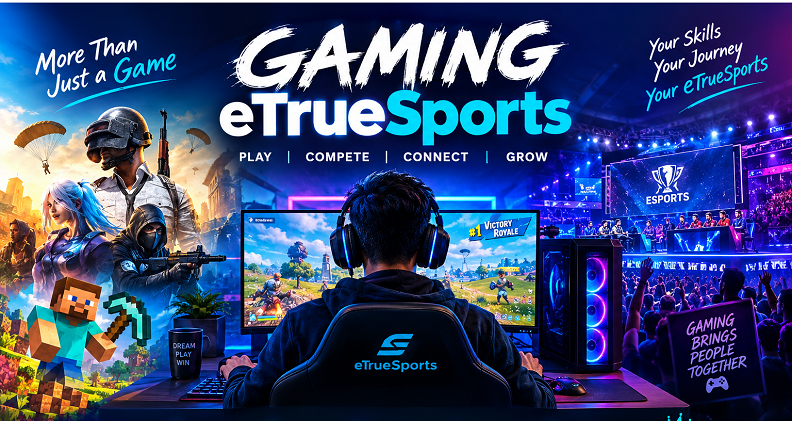

Gaming has evolved far beyond simple entertainment. Today, competitive gaming, esports tournaments, online communities, game streaming, and professional gaming have created a massive digital ecosystem. The term gaming eTrueSports can be used to describe the broader world of competitive and organised gaming where players compete, improve their skills, follow tournaments, and engage with gaming communities.
For many gamers, gaming is no longer simply about playing a game for fun. It can involve strategy, teamwork, communication, competition, content creation, streaming, and even professional career opportunities. Games such as multiplayer shooters, battle royale titles, sports games, strategy games, and multiplayer online battle arena games have helped establish competitive gaming as a global phenomenon.
The growing popularity of gaming eTrueSport is closely connected to better internet access, affordable smartphones, powerful gaming PCs, consoles, esports platforms, and social media. Players can now compete against opponents from different countries without leaving their homes.
Also Reed: How to Update ETSJavaApp by eTrueSports
Why Gaming eTrueSports Is Becoming Popular
One of the biggest reasons behind the popularity of gaming eTrueSport is accessibility. A player does not necessarily need expensive equipment to begin playing competitive games. Many popular mobile and PC games can be played with relatively affordable hardware.
Another important factor is the social experience. Modern games allow players to communicate with teammates, create communities, participate in competitions, and share their achievements online. Platforms for livestreaming and video content have also made professional gamers and esports personalities more visible than ever.
Competitive gaming also provides a clear sense of progression. Players can practise specific skills, improve their rankings, join teams, and participate in tournaments. This competitive structure makes gaming more engaging for people who enjoy challenges and measurable achievements.
Gaming eTrueSports and the Growth of Esports
Esports is one of the most important parts of the modern gaming industry. It transforms competitive video games into organised sporting-style competitions. Professional teams, coaches, analysts, commentators, tournament organisers, sponsors, and content creators all contribute to the esports ecosystem.
In a typical esports environment, players train regularly and develop game-specific strategies. Teams may analyse previous matches to identify weaknesses and prepare for future opponents. Communication and teamwork can be just as important as individual mechanical ability.
Major esports competitions can attract large online audiences. Fans follow their favourite teams, watch live matches, discuss strategies, and share highlights on social media. This has created a culture where competitive gaming can function similarly to traditional sports fandom.
Popular Types of Games in Gaming eTrueSports
Gaming eTrueSports is not limited to one type of game. Different genres offer different competitive experiences.
1. Battle Royale Games
Battle royale games place multiple players or teams into a large map where survival is the primary objective. Players must manage resources, understand the map, make strategic decisions, and win fights at the right time.
These games are popular because every match can develop differently. A player may need to adapt to changing circumstances, making decision-making extremely important.
2. First-Person Shooter Games
First-person shooters, often called FPS games, emphasise aiming, movement, reaction time, positioning, and teamwork. Competitive FPS games frequently use structured teams and objective-based gameplay.
Players need excellent reflexes, but raw speed alone is not enough. Map knowledge, communication, and tactical awareness can determine the outcome of a match.
3. Multiplayer Online Battle Arena Games
MOBA games combine strategy, teamwork, character abilities, and objective control. Players normally select different characters with specific roles and cooperate to defeat the opposing team.
Successful MOBA players often need strong game knowledge, communication skills, and the ability to understand complex situations quickly.
4. Sports and Racing Games
Sports and racing games bring traditional sports concepts into the digital world. Competitive players can participate in tournaments based on football, basketball, racing, and other sporting experiences.
These games can appeal to both traditional sports fans and gaming enthusiasts.
5. Strategy Games
Strategy games require planning, resource management, prediction, and decision-making. Instead of depending primarily on reflexes, players often win by developing better strategies than their opponents.
Essential Skills for Gaming eTrueSports
Becoming a successful competitive gamer requires more than simply playing for many hours. Players should focus on improving specific skills.
| Skill | Importance in Competitive Gaming |
|---|---|
| Game Knowledge | Helps players understand mechanics, maps, characters, and objectives |
| Reaction Time | Important for fast-paced competitive games |
| Communication | Essential for coordinated team play |
| Strategy | Helps players make better decisions |
| Teamwork | Allows players to work effectively with teammates |
| Concentration | Reduces mistakes during important matches |
| Adaptability | Helps players respond to changing situations |
| Mental Discipline | Supports consistent performance |
| Practice | Builds mechanical and tactical skills |
| Analysis | Helps identify mistakes and improve performance |
A good practice routine should focus on quality rather than simply increasing the number of hours played. Players can record matches, review mistakes, practise specific mechanics, and study advanced strategies.
Gaming eTrueSports Equipment
Equipment can influence a player’s competitive experience, although expensive hardware does not automatically create a professional player.
For PC gaming, a capable computer, responsive monitor, reliable mouse, keyboard, and headset can provide a comfortable competitive setup. For mobile gaming, a device with stable performance, responsive controls, and good battery life can be useful.
A stable internet connection is also extremely important. High latency or frequent connection problems can negatively affect competitive performance. Players should therefore pay attention to network stability as well as hardware.
Ergonomics should not be ignored. A comfortable chair, suitable desk height, proper screen position, and regular breaks can make long gaming sessions more manageable.
The Importance of Practice in Gaming eTrueSports
Practice is one of the foundations of competitive gaming. However, effective practice is different from playing casually for hours.
A player should identify weaknesses and create specific goals. For example, an FPS player might focus on aim accuracy, movement, positioning, or decision-making. A strategy-game player may focus on opening strategies, resource management, or tactical analysis.
Reviewing gameplay is another powerful technique. By watching previous matches, players can identify repeated mistakes. They can then develop specific solutions rather than repeating the same habits.
Professional-level improvement generally requires patience. Players may experience periods where their progress appears slow. Consistent practice and analysis can help maintain long-term development.
Gaming eTrueSports and Online Communities
Gaming communities are an important part of the esports ecosystem. Players can find teammates, discuss strategies, follow tournaments, exchange tips, and share gaming content.
Online communities also help new players learn. Experienced gamers often publish tutorials, guides, gameplay videos, and strategy discussions. Watching skilled players can provide ideas about positioning, decision-making, and game mechanics.
However, healthy online behaviour is important. Competitive gaming can sometimes create toxic interactions. Players should avoid harassment, cheating, abusive language, and other behaviour that damages the gaming experience.
A positive community encourages learning and competition while respecting other players.
Gaming eTrueSports and Streaming
Streaming has become another major part of gaming culture. A talented player can build an audience by livestreaming matches, explaining strategies, entertaining viewers, or creating educational content.
Gaming content can take many forms, including live gameplay, tutorials, reviews, tournament analysis, highlights, challenge videos, and gaming news.
Successful creators generally need more than gaming ability. Communication, consistency, creativity, editing skills, audience engagement, and personal branding can also be important.
This means gaming eTrueSports can connect competitive gaming with the wider creator economy.
Career Opportunities in Gaming eTrueSports
The gaming industry offers more career paths than professional gameplay alone. People interested in gaming can explore several different roles.
| Career | Main Responsibility |
|---|---|
| Professional Gamer | Competes in organised tournaments |
| Esports Coach | Helps players develop skills and strategies |
| Game Analyst | Studies, matches and competitive strategies |
| Streamer | Creates live gaming content |
| Gaming Content Creator | Produces videos and social content |
| Tournament Organiser | Plans and manages competitions |
| Esports Commentator | Provides live match commentary |
| Game Journalist | Reports on games and the industry |
| Video Editor | Produces gaming videos and highlights |
| Community Manager | Manages gaming communities |
This variety demonstrates that gaming can be connected to technology, media, marketing, entertainment, and digital business.
How to Start With Gaming eTrueSports
Starting competitive gaming does not require becoming a professional immediately. The first step is choosing a game that genuinely interests you.
Once you choose a game, learn its basic mechanics. Understand the objectives, maps, characters, weapons, abilities, scoring system, or other important mechanics.
Next, establish a regular practice schedule. Rather than playing randomly, create specific goals for each session.
Joining a gaming community can also help. You may find teammates, receive advice, and discover tournaments or competitive opportunities.
As your skills improve, consider participating in smaller competitions. These experiences can teach you how to handle pressure, communicate with teammates, and adapt to competitive environments.
Tips to Improve Your Gaming eTrueSports Performance
Focus on One Game
Playing too many competitive games at once can slow your progress. Focusing on one main game allows you to develop deeper knowledge.
Study Better Players
Watching skilled players can teach you strategies that may not be obvious during casual gameplay.
Review Your Matches
Do not only watch your best moments. Review mistakes and ask why a particular decision failed.
Improve Communication
In team-based games, clear communication can make a major difference. Keep messages short, useful, and relevant.
Take Regular Breaks
Long gaming sessions without breaks can reduce concentration. Short breaks can help maintain focus.
Maintain a Healthy Routine
Sleep, physical activity, hydration, and balanced daily habits can support concentration and overall performance.
Avoid Cheating
Cheating may provide short-term advantages but can destroy competitive integrity and result in penalties or bans.
Gaming eTrueSports: Challenges and Risks
Despite its many opportunities, competitive gaming also has challenges. One major issue is excessive gaming. Playing for too long without proper balance can interfere with education, work, relationships, sleep, and physical activity.
Another challenge is the pressure to perform. Competitive players may experience frustration after losing important matches. Learning to manage emotions is therefore an important part of becoming a better competitor.
Online toxicity is another concern. Players may encounter harassment, offensive language, or negative behaviour. Using moderation tools and avoiding harmful interactions can create a healthier gaming environment.
There are also financial risks. Not every gamer becomes a professional or earns significant money from gaming. Anyone considering gaming as a career should maintain realistic expectations and develop additional skills.
The Future of Gaming eTrueSports
The future of gaming and eSport is likely to be influenced by technological development. Faster internet, improved gaming hardware, artificial intelligence, virtual reality, cloud gaming, and better online infrastructure could create new competitive experiences.
Mobile esports may continue expanding because smartphones are widely accessible. PC and console gaming will also remain important for competitive titles that require advanced hardware and precise controls.
Artificial intelligence could become increasingly useful for game analysis, coaching tools, training simulations, and personalised practice. At the same time, esports organisations may continue developing professional training systems similar to those used in traditional sports.
The gaming industry is also likely to become increasingly connected to entertainment and digital media. Live tournaments, short-form videos, livestreams, sponsorships, and creator communities can bring competitive gaming to larger audiences.
Gaming eTrueSports vs Traditional Gaming
Traditional gaming is often focused primarily on entertainment and personal enjoyment. Competitive gaming adds another dimension by emphasising performance, rankings, teamwork, tournaments, and measurable improvement.
This does not mean casual gaming is less valuable. Different players enjoy games for different reasons. Some people play to relax, while others enjoy intense competition.
Gaming eTrueSport represents the competitive side of this broader gaming culture. It creates opportunities for players who enjoy testing their skills against others.
Why Gaming eTrueSports Matter
Gaming eTrueSport reflects the transformation of video games from a simple form of entertainment into a large digital ecosystem. Competitive gaming now connects players, fans, creators, teams, tournament organisers, developers, and businesses.
For aspiring players, the most important lesson is that success requires patience and discipline. Talent can help, but consistent practice, strategic thinking, teamwork, communication, and adaptability are equally important.
For casual gamers, gaming eTrueSport can simply provide an exciting way to follow tournaments, discover new games, and connect with other gaming fans.
(FAQs)
What is gaming eTrueSports?
Gaming eTrueSport refers to the broader concept of competitive and organised gaming, including esports, tournaments, competitive players, gaming communities, streaming, and related digital activities.
Is gaming eTrueSports the same as esports?
The terms are closely related, but gaming eTrueSport can be understood as a broader concept surrounding competitive gaming, while esports specifically refers to organised competitive video game competitions.
Can beginners participate in competitive gaming?
Yes. Beginners can start by learning a game, practising regularly, joining communities, and participating in smaller competitions before progressing toward higher-level tournaments.
What skills are important for competitive gaming?
Game knowledge, reaction time, communication, teamwork, strategic thinking, concentration, adaptability, and mental discipline are all valuable competitive gaming skills.
Do I need an expensive gaming PC?
Not necessarily. The required hardware depends on the game. Many competitive games can run on affordable PCs, consoles, or mobile devices. Stable performance and a reliable internet connection are often more important than having the most expensive equipment.
Can gaming become a career?
Gaming can lead to careers in professional play, coaching, analysis, streaming, content creation, tournament organisation, commentary, journalism, video editing, and community management. However, professional gaming is highly competitive, so realistic expectations are important.
How can I improve faster at competitive games?
Choose one main game, practise specific skills, study experienced players, review your own matches, improve communication, and maintain a consistent routine.
Is gaming eTrueSports only for professional players?
No. Competitive gaming includes everyone from beginners and amateur players to professional esports athletes. Players can participate at whatever level matches their interests and abilities.
What is the future of gaming eTrueSports?
The future may include stronger mobile esports, improved streaming, AI-assisted training and analysis, virtual and augmented reality experiences, cloud gaming, and increasingly professional esports ecosystems.
Conclusion
Gaming eTrueSports represents an exciting part of the modern gaming world. It combines competitive gameplay, technology, entertainment, community, streaming, and professional opportunities into one rapidly developing ecosystem.
Whether someone wants to become a professional esports player, start a gaming channel, participate in tournaments, or simply follow competitive games, there are many ways to become involved.
The key to success is not simply playing more. Smart practice, continuous learning, teamwork, discipline, and a healthy balance between gaming and everyday life are essential. As gaming technology and online communities continue to evolve, gaming eTrueSport is likely to remain an important part of digital entertainment and competitive culture.
For anyone interested in competitive gaming, the best time to start learning is now: choose a game, understand its mechanics, practise consistently, connect with the community, and enjoy the journey.